South Bank competition
(quagga: Jenny Mills, Jos Thorne, Alan Munro)
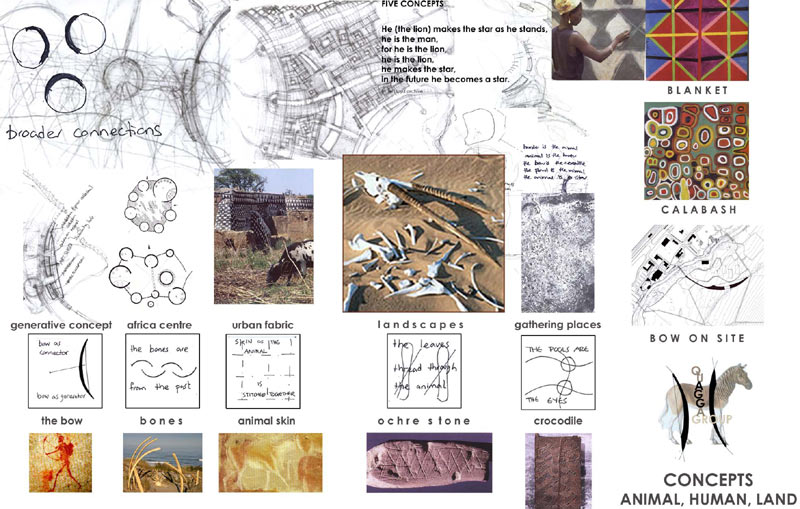
He (the lion) makes the star as he stands,
he is the man,
for he is the lion,
he is the lion
he makes the star,
in future he becomes a star.
- ~ (khoisan text underpinning concept)
We draw on the rich heritage of the Khoisan to find meaningful representations in the landscape and site, and especially the Khoisan concept of the relationship between animals and people. (For example: the transmutation between the animal world and the human world.) For not only is the Khoisan culture one of the oldest known it is also contextual to the site.
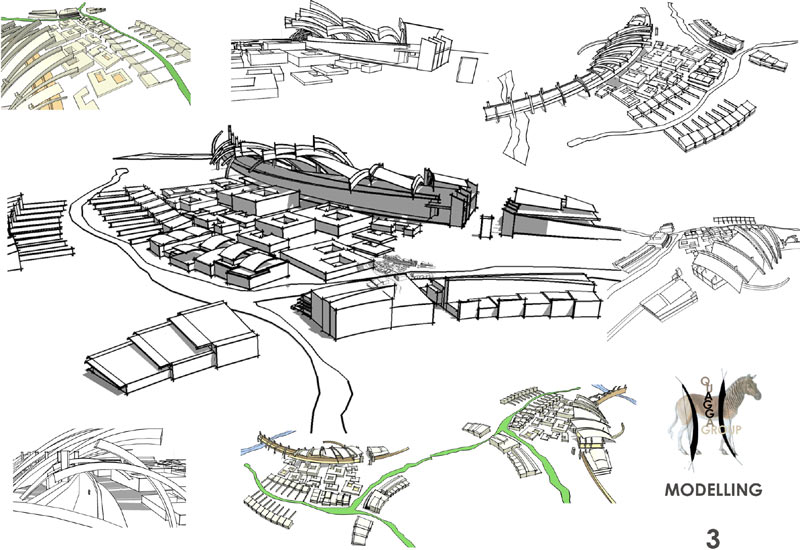
The project is seen as a living organism that celebrates the cyclical nature of life. The transfer of information is a dialectic one between those living on the South bank and those visiting it. Harmony between those inhabiting the space (people) and the space being inhabited (environment both natural and built) is paramount to a sustainable continuous life-cycle. The principle organisational concepts form the core organisational structures of the site plan and act as the generating forces for growth, transition zones and activity nodes.
FIVE ORGANISATIONAL CONCEPTS
- The Hunter and the Hunted
Our concept of permeability and sustainability incorporates the important balance acknowledged traditionally in Africa (and in many animalistic belief systems globally) between the animal world and the human world. - The bow as connector:
We use the bow and arrow as a symbol of the hunter and the hunted. The bow is symbolic of the moment when the eland was killed for the first time. It represents transition, and in the context of the Khoisan myth, it describes the god(mantis) not giving permission for the first kill (of the eland) and this being the defining moment when things transformed from one paradigm to another; when mans relationship to Africa changed – from tradition to modernity. - Bones are fragments of the past – animal as earth, as foundation, as organisational principles:
The bow and the bones are a reference to history, site, people and animals that have previously moved through the landscape. Markers, such as the bow and/or bones, are reminders of a fragmenting history, which has disturbed the ground, such as hunting, herding, colonialism, slavery and apartheid. This is like archaeology revealing history. - Pathways are tracks, movement, journey, traces, footprints and reveal identity.
Tracks corresponding to movement routes left by people and animals in the landscape are revealed in the ground plane and express ecological pathways leading from one activity to another. These become the routes through the site. - Open space as pools of origin and creativity.
These open activities zones are breathers in the urban fabric, they are containers or nodes for potential public and communal activity. They are the eyes of the animal, the pools from where creative life originates.